Friday, 5 October 2012

Public relations - the nature and importance

PRPs IN THE MAKING: Left to right: Loyiso, Siphokazi, Nic Mmako and Mmakwena at UJ Council Chambers
I dedicate the last academic blog to the author of Naked Issues - myself.

I wish to reflect on the wonderful blogging journey I've had to embark on. Not only has it been an academic booster, but through blogging, a whole new world was revealed for me. I got an opportunity to explore my writing and critical analysis skills particularly in the field of Public relations, communications and media studies.

This journey has also enabled me to evaluate myself in terms of having the understanding for the social events that have taken place over the last nine months. Sometimes we look at what is happening in the media and are very quick to draw subjective conclusions.

This journey has made me realize how important it is to always go deeper into issues and attempt to find the root cause of certain events before making baseless assumptions about other people; public figures and ordinary people.

It has also been an opportunity to scrutinize the important role that Public relations play in everyday events. The theoretical part of PR requires in depth concentration and attention to detail in order to have the right understanding of the subject at hand.  The weekly blogging journey has allowed me to glue the theoretical and practical aspects of PR, communications and media studies. 

As I conclude, I wish to point out a few distinctive lessons I've treasured from this experience:
  •  Public relations is important because at its core, PR revolves around this universal truth: people act based upon their perception of facts.
  • By managing, controlling, or influencing people's perceptions, public relations practitioners hope to initiate a sequence of behaviors that will lead to the achievement of an organization's objectives.
  • When public relations practitioners successfully create, change, or reinforce opinion through persuasion, their primary objective is accomplished.
For those who may have an interest to follow this dynamic field, here's a list of career opportunities for you:
 
·  Public Relations Specialist
·  Social Media Specialist
·  Public Speaker
·  Communications Coordinator
·  Communications Director
·  Communications Editor
·  Communications Representative 
·  Communications Specialist
·  Copy Writer
·  Corporate Communications Specialist, read more titles here

Saturday, 29 September 2012

BEE negatively perceived as a new version of apartheid!

 
ideate.co.za

Jhb - The Supreme Court of Appeal ruled it was within someone's right to give bursaries to only white students, according to a report on Saturday.

The ruling came after Daphne de Villiers from Stellenbosch in her last will and testament determined that the trustees of the Jean Pierre de Villiers Trust, which she created, must allocate R250 000 yearly to white students at four universities for certain degrees, Beeld reported.


This got me thinking about how the issue of race is still very sensitive in South Africa. Which also reminds me about the misunderstandings around Black Economic Empowerment (BEE). A lot of people don't understand what BEE really is and how it necessary in the times we live in.

To many, BEE seems like a way of the democratic government to bring back apartheid in a different version. Most recently, a friend of mine who's white couldn't get a job at a certain company because it is linked to BEE.

I believe that it is actually the confusion or misunderstanding around what BEE really is that's contributing to the lack of unity, tolerance and acceptance of one another amongst South Africans of different races.

The need for effective communication on Black Economic Empowerment.

BEE is a very serious and controversial issue and this is mainly because many people aren't aware as to what it's purpose is. Therefore government shouldn't turn a blind eye on the confusion that's held by some members of the public. 

  • An enhanced communication strategy should be put embarked on to ensure that all South Africans understand why BEE is necessary and how it really works.
  • The communication strategy should also be designed in such a way that it can be understood by all members of the public regardless of their education level and other factors.
  • Just as there're campaigns on road safety, alcohol usage and community safety, there should also be a campaign whose primary objective is to educate the public on how BEE works, who benefits and why. This will help create a mutual understanding between government and its stakeholders.
Read more on: News24

Saturday, 22 September 2012

The controversial e-tolls AKA "e-thief" gets the go ahead from the court in Gauteng


THE BIG DEBATE: Members of the public still don't agree with SANRAL's e-tolls. Photo: thenewage.co.za


As Anna Cox and Brendan of The Star write... "Does the government have the wherewithal to handle civil disobedience threatened by 2 million disgruntled motorists?"

Wayne Duvenhage, Chairman of Outa says laws and policies are no good unless they are enforced, and with such huge public opposition, the government will find it logistically and practically difficult to enforce the tolls.

Government could struggle to manage the large numbers of disgruntled motorists.

Here are some of the challenges that government could face from motorists:

1. The Constitutional Court case to be heard in November - motorists might not buy e-tags as ther're still some pending decisions regading e-tolls.

2. The absence of disobedience from motorists will be a huge challenge for the government to overcome;

3. If the public could stand together against e-tolls by not registering for e-tags, ignoring tolling costs and consequent fines;

Cosatu warned the government not to “even think” about implementing e-tolls until consultations were done, and threatened mass action should they be implemented.

Possible solutions for the contoversial e-tolls

1. Clearly there's a communication breakdown between government and the public, so communication should be enhanced so that the public will have a mutual understanding about the e-tolls;

2. Government should be willing to listen to the public's opinions and implement the e-tolls system in a mutually understood way, not only in favour of government;

3. There should be maximum transparency regarding e-tolls so that the all members of the public can understand exactly why there's a need for e-tolls.

These are only a few of many things which I think government shouldn't take for granted as they the potential to cause instability in SA.

Friday, 14 September 2012

Julius Malema's strategic political come-back plan is in place

THE UNANTICIPATED POLITICAL COME-BACK STRATEGY: Former ANCYL president Mr Julius Malema is surrounded and praised by hundreds of Marikana miners and residents during a march against minimal wages. Photo: BBC News Africa.
I couldn't ignore the fact that Marikana Massacre continues to make headlines in the social, electronic and print media every single day.

This time I would like to discuss how the expelled ANCYL president Mr Julius Malema saw a political recuperation opportunity in the tragic massacre

So, where is Public relations in all this?

Persuasive communication happens when a communicator succeeds in voluntarily forming, changing or modifying the attitudes of an audience though the presentation of his/her message.

Malema uses persuasive techniques to steer the miners in his desired direction; and he has managed to convince the miners that he is on their side far as their grievances are concerned.
  • Audience analysis in PR is a fundamental element which suggests that  a communicator has to know the needs of his/her audience before addressing them. Malema has succeeded in this regard because he is pushing for the miners' R12 500 salary increase - an indication to the miners that he's indeed on their side.
  • Appealing to the emotional state of a communicator's audience is also a very significant technique to use to achieve one's objectives. Malema's strategic plan couldn't have come at a better time than now when miners are still grieving over the passing of their colleagues. They will not stop until they get what they want considering the pain they've been subjected to.
  • Last but not least,the credibility, trustworthiness and reputation of a communicator plays an important role in persuading the audience. As far as ethos is concerned, Malema is known for advocating for mines to be nationalized in SA, this is working in his favour at the moment because the miners will be easily persuaded as they know that he is a person who has always been concerned about the activities within the South African mining industry.
Read more from: BBC News Africa

Friday, 24 August 2012

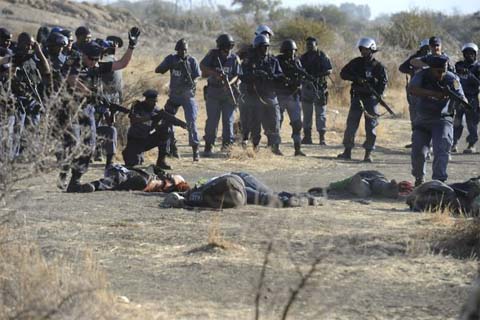
Marikana massacre - a Public relations mess for both the SAPS and Lonmin mine


"SHOOT TO KILL": Members of the SAPS watch as Lonmin platinum mine workers lie breathless and defenceless on the ground after being shot like useless animals by police officers during their strike against minimal wages.
Photo adapted from:  bolekaja.wordpress.com
There are so many things to be said about the tragic Marikana massacre whereby at least 34 people were shot dead and 80 more injured when police opened fire on striking workers at a platinum mine in Marikana, in the North West province of South Africa last Thursday [August 16].

One thing I'd like to discuss is the Public relations mess in which the SAPS and Lonmin mine find themselves in. PRPs have to get to work and clean up this mess!

The SAPS's reputation has gone from neutral to negative!

We all know that the SAPS still has a lot of issues to address in order to be perceived in a good way by the public, challenges facing the SAPS at the moment include amongst others:
  • The brutality of police officers;
  • The negativity caused by former National Police Commissioner Mr Bheki Cele's corrupt activities;
  • The newly appointed National Commissioner with no police experience (Mrs Riah Phiyega)
On top of all this - the Marikana massacre has just made matters worse for the image of police. Now the PRPs will have to put measures in place to restore the dignity and good image of the SAPS and also to change the negative perceptions and attitutes held by the publics!

Lonmin Platinum Mine is losing millions and it's certainly on the verge of losing investors because of greed!

Lonmin makes billions of rands every year and they achieve that through hardworking, poor and unhappy miners. This is greed! How could I give my worker as little as R4000 monthly while I make millions through their hard labour?

Lonmin also has to work very hard to restore their desired image. Failure to do so will see investors pulling out because of this incident. Who wants to do business with a company that treats it's employees like garbage?

A public relations lesson to be learned from the Lonmin Massacre:
  • The SAPS took their time to address the brutality of police officers, it got worse and resulted in the Marikana massacre.
  •  PRPs always need to be proactive towards any issue arising in their organisations rather than having to be reactive at a later stage.
  • Lonmin turned a blind eye on the needs of their starving miners who then took matters into their own hands.
Read more on the Marikana Massacre from: Mail & Guardian 

Friday, 17 August 2012

Bobby Motaung's arrest could have a negative impact on the Kaizer Chiefs brand

Kaizer Chiefs' Bobby Motaung arriving in Nelspruit  (picture from Twitter)
It's not only politicians who're giving us this corruption! 

The arrest of Kaizer Chiefs' caretaker Bobby Motaung can only prove one thing - that corruption is not only amongst government officials! I've always thought that the private sector was so innocent when it comes to all the activities of corruption we always hear about by our local politicians. It looks like I was very wrong!

When the news about the arrest of Booby Motaung hit my ears, it was really an element of surprise. Motaung was arrested by the Hawks on Wednesday on charges of fraud - it has been reported that Motaung was arrested in connection with alleged tender fraud and corruption related to Mpumalanga’s R1.2-billion Mbombela Stadium.

Motaung is a director of Lefika Emerging Equity (Pty) Ltd, which won a tender to design the stadium. The construction of the stadium has been fraught with allegations of fraud and corruption that might have led to the assassination of former Mbombela council speaker Jimmy Mohlala.

From a PRP's desk, Motaung's arrest could have a negative impact on the Kaizer Chiefs brand!

It now seems like Motaung's arrest has something to do with the death of former Mbombela council speaker Jimmy Mohlala, but we can only wait for the trial to commence. If this turns out to be true, Amakhosi might find themselves losing a lot of support from the Nelspruit side.

I would personally not be happy to support Kaizer Chiefs especially when they play at Mbombela Stadium knowing that the Stadium was build on dirty money and blood. Kaizer Chiefs now has to work extra hard to ensure that they don't lose supporters following this unforeseen and unfortunate incident otherwise the reputation might go down the drain!

Friday, 10 August 2012

National Women's Day recognises only women in the ANC

South Africans celebrate Women's Day 2012 - Pretoria.
Photo by: demotix.com
Women's Day is supposed to be for all women in Mzansi

The national women's day is supposed to be the day whereby all women, from all over the country are recognised as people who have had a very significant role in the liberation of South Africa. I was very disturbed to learn that there are women living in SA today without proper houses, no jobs or benefits whatsoever.

Forced into the army at childhood against apartheid - but it was all for nothing!

These are not just ordinary women, they are women who had to leave SA to become soldiers in exile. Some of these women left the country at a very early stage of their lives, some as young as 14 years old. Today these women are living in shacks, they're jobless and are not recognised by the ANC led government as what one would call freedom fighters because they were never members of the ANC.

PAC:
 one of the political parties which
 played a significant
 role in the liberation of SA,
 today very little is said about them.
This is quite disturbing for me. Why is it that only women who are associated with the ANC get recognition for the fight against the apartheid regime? We constantly see and hear about women such as Winnie Madikizela Mandela, Charlotte Maxege, Adelaide Tambo and others. But what about women who belong to other political parties who also fought for liberation? Don't they deserve to be applauded for their efforts?

Where are women from other political parties who also fought tirelessly for this freedom? 

Have we been led to believe that women in the ANC Women's League are the only ones who marched to the Union Buildings to fight for our rights and therefore those who are members of the ANC will not be recognised by the government or have streets, museums and hospitals be named after them.

Friday, 3 August 2012

”Team SA” is “too white”: white South African Athletes' success at the London Olympics 2012 becomes a racial issue and negative publicity for SA

South Africa's positive image during the 2010 FIFA World Cup Tournament VS London olympics 2012

EARLY TRIP BACK HOME FOR BANYANA BANYANA : 
SA national women football team failed to progress
to the finals of the London Olympics 2012
In 2010 South Africans were all united behind the national football team (Bafana Bafana) during the 2010 FIFA World Cup Tournament. We projected a very positve image to the rest of the world.


The spirit of 'Ubuntu' reigned among us, for a few weeks we lived in what seemed like a non racial South Africa — free from racial prejudice. Our hearts were all  in delight as we were the host nation of the 2010 FIFA World Cup Tournament.


A very positive and appealing image of South Africa was showcased. I personally felt like I was beggining to enjoy living in the kind of South Africa which the great Nelson Mandela had always stood up for.


Happiness, glitter and glamour could best describe the feeling which I possessed during the 2010 FIFA World Cup Tournament. Some moments of the South African 2010 FIFA World Cup Tournament appear to have all been a distortion of reality.

Just two years later, the real image of South Africa is resurfacing

The London Olympics 2012 are currently underway. Two white South African  athletes have scooped gold medals: two in swimming and one in rowing won by the South Africa four -- James Thompson, Matthew Brittain, John Smith and Sizwe Ndlovu. It's been about two years since the 2010 FIFA world the 18 year old democratic South Africa's real problems or should I say challenges are now resurfacing.
WHITE, JOYOUS AND PROUD:
Cameron van den Burgh won a gold medal in
 swimming at the London Olympics 2012

Cameron van den Burgh and Chad Le Clos' success for having won gold medals at the Olympic games in London, has raised complaints that ”Team SA” is “too white”. the sight of two young white men winning gold medals have not been good news for all South Africans.

Is it plain jealousy or is there a deep issue about few blacks in TeamSA at the London olympics 2012?

Sapa reports that expelled ANC Youth League president Julius Malema has defended the racial make-up of the SA Olympic team after suggestions that it was too white. When questioned about lack of black people in TeamSA at the London Olympics 2012. Malema said the team members were chosen because they were qualified.
“We think that we’re a non-racial country and all South Africans who have qualified to make Team SA should carry the flag proudly, and we support them,” he said.
Clearly, there is a crisis here but what is it going to take for South Africa to get through the profound issue of racism? When are going to stop blaming things on skin colour?  Are we ever going to live in real unity without soccer "uniting" us?

Thursday, 3 May 2012

Music piracy is here to stay!

TOPPING THE LIST: Zahara won Album of the Year at the 18th Sama Awards held at Sun City. She also won Female Artist of the Year, Newcomer of the Year, Best Selling Album, Best Smooth Urban Music Album and Best Collaboration. PHOTO: COBUS BODENSTEIN

We recently witnessed the 18th South African Music Awards (SAMAs), one of our local artists, Zahara walked away with 8 awards!

The reality of music piracy!

However, it is not happiness all the way. the issue of music piracy threatens the music industry in SA.

Music piracy is one of the main reasons why young and upcoming local artists don't make it as artists in South Africa. It is a problem that has been going for a long time and it doesn't look like it's going anywhere!

Some of the most pirated artists in South Africa include: Arno Carstens,  Rebecca Malope, Mandoza, Joyous Celebration and the late Brenda Fassie.

There's been attempts by local musicians to fight against piracy but it doesn't seem to be working!

A pirated CD is cheap!

A genuine CD costs about R100 in store, a pirated copy of the same CD ridiculously costs between R5 and R10 from street vendors.

Unemployment is incresingly high, street vendors will do anything it takes to put some bread on the table!

Ordinary citizens don't want to spend a fortune on a single CD that's going to be scratched after a few days. So they'll continue to buy pirated music.

It's wrong to do that, but the reality of the matter is that it saves people money and they won't stop doing it!

What is government doing about music piracy?

From a PR angle, government has realised that piracy is slowly but surely killing the country. Among other activities, Department of Trade and Industry proposed new Anti Piracy Campaign which would see the creation of a commission to prevent intellectual property theft predominantly in the music industry.

But I don't think this is enough, people's perceptions and behaviour won't be changed by a campaign that simply says: "Be original, buy original"!

More work needs to be done. In the meantime, sharing  and copying of music continues and artists are gaining peanuts!

Thursday, 26 April 2012

The reward you get when you act against poor service delivery in SA.


KILLED FOR BEING AGAINST POOR SERVICE DELIVERY : Ficksburg Teacher, Andries Tatane lies bloodied and lifeless after being beaten and allegetly shot by police.

(Picture by: Willem Van Der Berg/Volksblad.)


 Andries Tatane was killed on April 13, 2011 , during a march against poor service delivery in Ficksburg, Free State Province.

I've always believed that he was an innocent man who was killed because he hated poor service delivery, but Johann Nel, one of the seven policemen accused of beating Tatane to death, said the Teacher was not a peaceful protester who tried to protect older people during a protest march in the town as it had been alleged by the media.

Nel said in a video of the protest, shown to the court on Wednesday, a discussion could be heard that Tatane tried to enter the municipal building unlawfully.

"Tatane tried to enter... tried to get the keys of the building and is not the peaceful man you tried to convey to court."
Let's look at this naked issue from a PR view, surely we all know that a lot of service delivery protests in South Africa always turn violent. We've seen in the past people turning protests into opportunities to steal from others or vandalising property.

We may all been convinced that Tatane was just an innocent man trying to voice out his views just like any other person, but the media always wants to sell and will go an extra mile by sensationalising and twisting stories.

As much as I believe that the shooting by the police took place, I think we can argue that perhaps the police are just unfortunately being framed  by the media to look like they're are heartles and brutal (the framing theory).

Sometimes our police face the danger of losing their lives as well due to unruly and violent protesters and they have to respond by force,  isn't there a possibility that the same thing might have happend in this incident?

The media is there to keep us informed about what's happening around us, but we need to understand that they also choose what they tell us, how they tell it and also how they want us to react to what they tell us (propaganda). Which is probably why police often appear as the monsters in our society.

This is my view, what's your view on the matter?

Thursday, 19 April 2012

Zuma leading by example on culture?

PREPARING FOR THEIR BIG DAY: South African President Jacob Zuma with his fiancee Gloria Bongi Ngema
 Photo: EPA

A traditional ceremony is expected to take place in Zuma's home village of Nkandla, in South Africa's eastern KwaZulu-Natal province.

There's always been concerns from quite a number of South African citizens about the president's value in his cultural practice (poligamy).

A lot of people were arguing that the tax payers' money was being misspent on maintaining the life of Zuma and his family rather than using it on service delivery.

Perhaps we can all relax now because things are going to be different in this case, the spokesperson to the president, Mac Maharaj said in a statement: 
" The cost of the ceremony is to be paid by the president with there being no government expenditure involved."

Maharaj also said that the spouses will also pay for their own living or household expenses, be it food, mortgages, lights, and water.

The public relations angle in story can be derived from  the theory that in today’s sensitive business environment, any organization’s ultimate survival may well depend on developing and maintaining a recognizable image and favorable reputation.

We can argue that Zuma is trying to create the perception that as the head of state, he is able and willing to relief tax payers from funding yet another wedding.

He may be successful in this endevour because this suggests that he is not prepared to use ordinary citizens for his personal benefit as president.

We all have our own cultures that we cherish, but I've personally noticed that at any point of our engagements our cultures will clash.

My question therefore is:

When someone becomes president of a country, would it rather be easier to put personal culture aside and let it not interfere with their professional role or would that be a sign of looking down on our own cultures? 
 

Thursday, 12 April 2012

Why wait for Mandela Day to make a difference?


NO CHOICE: Children have their lesson under a
 tree at one of the poor schools in South Africa.


Source: omeidatrading178.co.za
 
A new campaign to alleviate the infrastructure backlog in primary schools in poor communities will make a significant contribution to fulfilling Nelson Mandela’s dream for every child in South Africa to be educated. 

The primary objective of the 94+ Schools Project for Madiba is to celebrate Mandela’s 94th birthday by giving hope and dignity to children in at least 94 schools, among them schools in Johannesburg, through improvements to school infrastructure.

The initiative was launched by the Department of Basic Education in partnership with the Nelson Mandela Foundation ahead of this year’s Nelson Mandela Day, which is celebrated every year on the former statesman’s birthday, on 18 July.

It was officially declared in 2009 by the UN as an annual international day in honour of the Nobel Peace Prize laureate. The aim of the day is to inspire individuals to take action to help make the world a better place.

The initiative was launched by the Department of Basic Education in partnership with the Nelson Mandela Foundation ahead of this year’s Nelson Mandela Day, which is celebrated every year on the former statesman’s birthday, on 18 July.


It was officially declared in 2009 by the UN as an annual international day in honour of the Nobel Peace Prize laureate. The aim of the day is to inspire individuals to take action to help make the world a better place.


At the campaign’s launch, Basic Education Minister Angie Motshekga said that the new project would change the lives of thousands of pupils.

Her department has identified 94 schools in all nine provinces in need of urgent infrastructure upgrades. Children and teachers in some of these schools get by with less than the basics. Children are taught in mud structures and don’t have any sport facilities, any sanitation or running water.


“Former President Nelson Mandela’s 94th birthday presents the [department] with a rare opportunity to do good with our school infrastructure,” Motshekga said.


Basic Education’s director-general, Bobby Soobrayan, said that with the campaign, the department wanted to create an environment that was conducive to quality teaching, learning and improved performance in targeted schools.

“Public-private partnerships are one of the most effective ways to meet infrastructure backlogs,” Soobrayan said.

Motshekga said Mandela forged invaluable partnerships with the private sector towards the building of schools, particularly in poor communities – an initiative on which the education sector could build.


It is good that the poor schools will benefit from this kind of project, however, there're so many challenges in this country that need to be addressed. The issue of poverty is still ongoing, unemployment, poor service delivery, and not forgetting corruption!


Why must we wait for Mandela's birthday to make the difference where it is needed? shouldn't it be an everyday thing to help those who are in need?

Friday, 30 March 2012

Thuli Madonsela says the new info bill will make her job difficult

The new protection of state information continues to be more and more controversial. Ordinary South African citizens are not the only ones who are unhappy about it. Just to prove that, Thuli Madonsela, Public Protector said on Wednesday, March, 27 2012 that in its current structure, the information bill will trip her up in her job.
Mandosela warns that the Protection of State Information Bill, if not exposed to changes, will make the work of her office difficult to execute.
She said whistleblowers would be discouraged from coming forth with important information about wrongdoing and that her staff would be at risk of being taken to prison for carrying such information.
Like many other people, Madonsela said to the members of the parliamentary that she agrees that there has to be some degree of state secrecy was needed, but said that the current version of the draft law was going to contradict the constitution.
When asked how the bill would affect her office, the Public Protector said “Will I be affected? Yes. Severely,”
She added by saying “We will not be toothless, but we are going to function under more onerous circumstances,”
It appears to be clear that the new Protection of State Information needs to be reviewed. We cannot afford to have a bill that threatens to bring back some elements of apartheid.
The message to the members of the parliamentary dealing with the Bill is simple: The Bill must be changed to fit in the new democratic South Africa.

Friday, 23 March 2012

Are we less informed or do we just don't care?

Ayanda Masondo, 20, a second-year UJ Public relations student from Newcastle in KwaZulu-Natal, was found leaning against the door in her room, in the Benjemijn hostel, on the morning of Sunday, 19 March 2012 .

Paramedics were called, but they pronounced her dead at the scene.

Brixton police station spokesman Constable Michael Kgatle said there would be a judicial inquiry into Masondo’s death.

“At this stage an illegal abortion would appear to be the reason for her death. There was a lot of blood at the scene,” Kgatle said.

According to Ayanda’s friends, she had been ill for about a week before she died.

A friend to Ayanda was quoted by Sowetan as having said “She was such a quiet girl. We’re all incredibly upset by this,”

It is heart-breaking for a young lady like her to die while busy chasing her dreams. Adjusting one's life from high school to university is a big deal, any student needs support.

Its disturbing to know that Ayanda would resort to the decision she took when there are support services offered by UJ to help students cope with problems.

The Centre for Psychological Services and Career Development (PsyCaD) is one of the services that are available for students at all four campuses of UJ. The following services amongst others, are offerered by PsyCaD :
  • It runs a Peer Buddy group that helps students find their feet at the university;
  • It Offers counselling services for students with all kinds of problems, personal or otherwise;
  •  PsyCad offers various career services, advising students and linking them with prospective employers;
  • It offers highly professional and completely confidential, sympathetic and scientific support.
  • And should a student happen to experience a major life crisis, PsyCaD runs a 24 hour Crisis Line that is a phone call away.
Clealy these services are sufficient for students both academicaly and personally. The question I ask therefore is: are students not well informed about these services or are they simply ignorent towards them?

We need a solution for this problem very soon or else we will see many more students with potential drifting away.